Vitamins That Give You Radiant, Youthful Skin
You want glowing, bouncy, “did-you-just-get-back-from-vacation?” skin? Start with vitamins. Skincare products help, sure, but nutrients are the behind-the-scenes crew that make your skin look alive on camera.
The right vitamins support collagen, fight dullness, and protect your face from the chaos of UV and pollution. Let’s decode which ones actually matter—and how to use them without turning your bathroom into a chemistry lab.
Why Vitamins Matter for Your Skin Barrier
Your skin barrier works like a bouncer at a club: it keeps the good stuff in and the chaos out. When it’s strong, you get smooth texture, fewer breakouts, and that healthy sheen.
Vitamins fuel this system from the inside and outside. Key benefits vitamins deliver:
- Collagen support for firmness and bounce
- Antioxidant defense to fight dullness and fine lines
- Moisture retention so you look dewy, not dusty
- Even tone by reducing dark spots and redness
Vitamin C: The Brightening Workhorse
Vitamin C is your glow vitamin. It helps your skin make collagen and fades dark spots while fighting free radicals. Yes, it’s popular for a reason. How to use it:
- Topical: Look for L-ascorbic acid (10–20%) or stable derivatives if you’re sensitive.Pair it with sunscreen in the morning for max protection.
- Oral: 75–120 mg/day from food or supplements supports overall skin health. Think citrus, bell peppers, kiwi.
Pro tips for Vitamin C
- Keep it away from air and light. If it turns dark orange/brown, it’s oxidized—FYI, toss it.
- Layer over a gentle hydrating serum if you’re sensitive.No need to suffer for the glow.
- Don’t mix with benzoyl peroxide at the same time—it can deactivate vitamin C. Alternate.
Vitamin A (Retinoids): The Texture and Fine-Line Tamer
Retinoids are the boss of skin renewal. They speed cell turnover, boost collagen, soften fine lines, and clear breakouts.
They can also be spicy—start slow. How to use it:
- Topical: Start with retinol 0.2–0.5% 2–3 nights a week. Work up to stronger formulas (retinaldehyde or prescription tretinoin) if you tolerate them.
- Oral: Don’t take high-dose vitamin A supplements for skin unless your doctor says so. Excess A can harm your liver and cause birth defects.Not cute.
Retinoid survival guide
- Sandwich method: moisturizer → retinoid → moisturizer. Your face will thank you.
- Use at night. Always wear SPF the next day—retinoids make skin sun-sensitive.
- Expect an adjustment phase (aka the “retinization” era).Redness and flaking calm down in 2–6 weeks.
Vitamin E: The Soothing Sidekick
Vitamin E plays support to vitamin C like the best friend in a rom-com—reliable and calming. It helps repair the skin barrier and reduces oxidative stress. How to use it:
- Topical: Look for “tocopherol” or “tocopheryl acetate,” often paired with vitamin C. Great for dry or mature skin.
- Oral: You usually get enough from nuts, seeds, and oils.Supplements are rarely needed unless your diet is lacking.
When Vitamin E shines
- Post-retinoid dryness or irritation
- Cold weather barrier repair
- As a partner to vitamin C in your morning routine
Niacinamide (Vitamin B3): The Multitasker You Can’t Mess Up
Niacinamide does a little of everything: brightens, shrinks the look of pores, improves texture, eases redness, and strengthens the barrier. It’s also easy to tolerate—IMO, it’s like skincare for the risk-averse. How to use it:
- Topical: 2–5% works for most. Go higher (up to 10%) if your skin tolerates it, but more isn’t always better.
- Oral: You get B3 from foods like poultry, tuna, mushrooms, and fortified grains.Supplement only if advised by a pro.
Smart pairings
- Niacinamide + hyaluronic acid = hydration and smoother texture
- Niacinamide + retinoids = less irritation and better barrier support
- Niacinamide + vitamin C = totally fine; use together or separate if sensitive
Vitamin D: The Quiet Defender
Vitamin D helps modulate inflammation and supports overall skin function. Low levels can tie into dryness or inflammatory flares. How to get it safely:
- Short, sensible sun exposure or a D3 supplement (check with your doctor for dosage—common ranges are 600–2000 IU/day).
- Fatty fish, fortified dairy/plant milks, egg yolks—solid food sources.
Sun and skin balance
- Don’t skip sunscreen to “get your D.” Supplement instead. Your future self (and your collagen) will cheer.
- If you’re indoors a lot, darker-skinned, or live far from the equator, consider checking your levels.
Biotin (Vitamin B7): Overhyped or Helpful?
Biotin’s famous for hair and nails, but for skin, the evidence is… not strong.
Deficiency can cause rashes, but most people get enough from food. What to know:
- High-dose biotin can mess with lab tests (like thyroid or troponin). FYI, tell your doctor if you take it.
- Focus on a balanced B-complex diet: eggs, legumes, seeds, sweet potatoes.
Antioxidant All-Stars Beyond the Basics
A few bonus players deserve a shout-out. They’re not vitamins in the classic sense, but they behave like skin superheroes.
- CoQ10: Helps cellular energy and softens fine lines.Great in lightweight serums.
- Resveratrol: Calms redness and fights environmental damage. Plays well at night.
- Alpha-lipoic acid: Potent antioxidant; go slow if you’re sensitive.
- Polyphenols (green tea, cacao): Drink them or put them on your face—either way, skin wins.
Topical vs. Oral: Where Should You Focus?
You don’t have to choose.
You get different benefits from each route. Topical (fast, targeted):
- Vitamin C for brightening and spot-fading
- Retinoids for texture, fine lines, congestion
- Niacinamide for pores, redness, barrier support
Oral (steady, foundational):
- Vitamin C, D, E from food or modest supplements
- Omega-3s (not a vitamin, but clutch) for calm, supple skin
- Protein for collagen building blocks—your skin needs the bricks, not just the blueprint
Simple daily combo (IMO, no-brainer)
- Morning: cleanse → vitamin C serum → moisturizer → sunscreen
- Evening: cleanse → niacinamide (optional) → retinoid → moisturizer
- Daily diet: colorful produce, lean protein, healthy fats; consider D3 and omega-3 if needed
What Actually Moves the Needle (and What Doesn’t)
Let’s be blunt: you don’t need 14 serums. You need consistency, SPF, and a few proven vitamins.
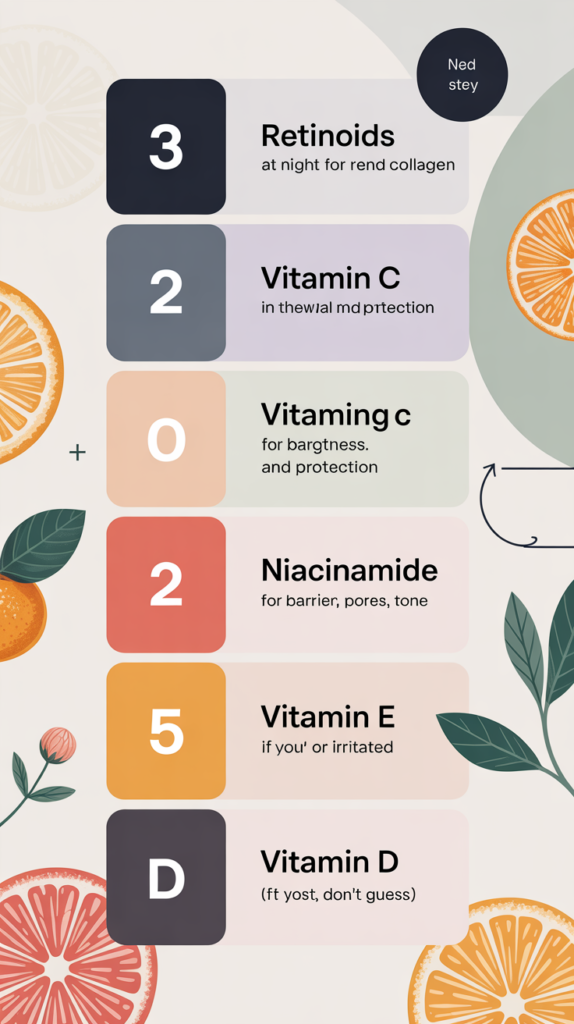
Prioritize these for radiant, youthful skin:
- Retinoids at night for renewal and collagen
- Vitamin C in the morning for brightness and protection
- Niacinamide for barrier, pores, tone
- Vitamin E if you’re dry or irritated
- Vitamin D if you’re low (test, don’t guess)
Skip the noise like mega-dose biotin or random gummy stacks. Your wallet and your skin barrier will be happier.
FAQs
Can I use vitamin C and retinol together?
Yes, but not in the same step if you’re sensitive.
Use vitamin C in the morning and retinoids at night. If your skin tolerates both, you can layer with a buffer (hydrating serum between), but separating AM/PM keeps things simple and effective.
How long until I see results from vitamins?
Topical vitamin C can brighten in 2–4 weeks. Retinoids improve texture in 6–12 weeks and fine lines in 3–6 months.
Oral changes take longer—think months, not days. Consistency beats intensity every time.
Do I need a vitamin supplement for skin?
Not always. If you eat a balanced diet and wear sunscreen, you can get most of what you need.
Consider supplementing vitamin D (if levels are low) and omega-3s. Ask your clinician before adding new supplements, especially if you take meds.
Which vitamins help with hyperpigmentation?
Vitamin C and niacinamide are MVPs. Add retinoids at night to speed turnover.
For stubborn spots, combine with sunscreen (non-negotiable) and consider azelaic acid or tranexamic acid as supporting players.
What if I have sensitive or acne-prone skin?
Start slow and simplify. Choose gentle vitamin C derivatives (like sodium ascorbyl phosphate), lower-strength retinoids, and 2–5% niacinamide. Patch test new products.
And keep your moisturizer and SPF boring but reliable.
Can I get enough vitamins from food alone for great skin?
Often, yes. Load up on colorful fruits and veggies, nuts and seeds, fatty fish, and whole grains. Supplements help fill gaps, but they won’t outshine a solid diet or consistent SPF—no matter what the marketing says.
The Takeaway
Radiant, youthful skin isn’t a mystery—it’s a routine.
Lock down the basics: vitamin C in the morning, retinoids at night, niacinamide for backup, sunscreen always. Eat like you love your skin, consider vitamin D if you’re low, and don’t fall for glittery promises. Keep it consistent, keep it simple, and watch the glow follow.